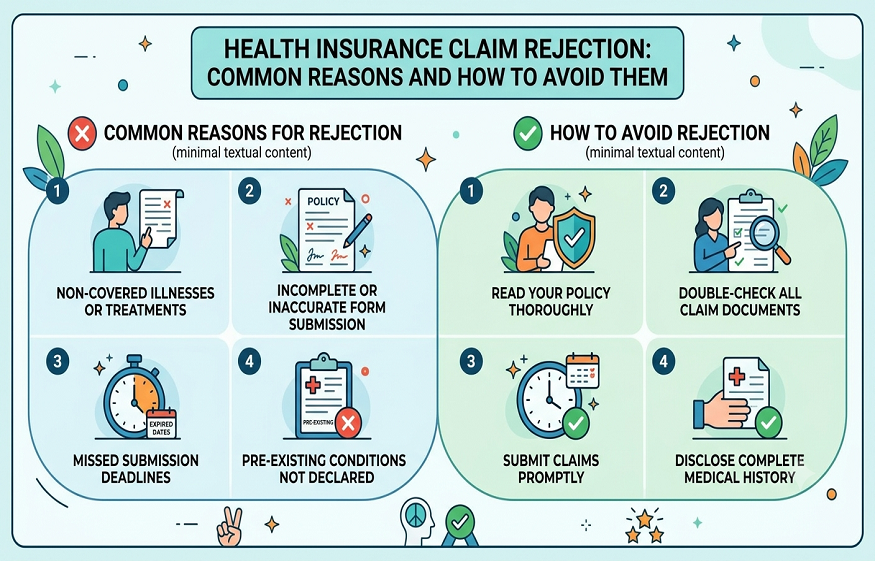
Health insurance is designed to provide financial support when medical expenses arise. However, having a health insurance policy does not automatically guarantee that every claim will be approved. A claim can be rejected if the policy conditions are not met, required information is missing, or the treatment falls outside the scope of coverage.
Understanding the common reasons for health insurance claim rejection can help policyholders avoid mistakes and improve the chances of a smoother claim settlement. Whether you are purchasing your first policy or reviewing your existing health India insurance, knowing the claims process is an important part of making an informed insurance decision.
What Is a Health Insurance Claim Rejection?
A health insurance claim rejection occurs when an insurer declines a claim because it does not meet the applicable policy terms and conditions. Rejection can happen during cashless treatment or when a policyholder submits a reimbursement claim after paying the hospital bills.
A rejected claim does not necessarily mean that the policy is ineffective. In many cases, the rejection may be linked to exclusions, inadequate documentation, incorrect information, or failure to follow the insurer’s claim procedure.
Common Reasons for Health Insurance Claim Rejection
1. Policy Exclusions
Every health insurance policy has certain exclusions—medical conditions, treatments, procedures, or circumstances that are not covered. If a claim relates to an excluded treatment or expense, the insurer may reject it.
Before buying a policy, carefully review the inclusions and exclusions. This is particularly important when comparing different health insurance plans.
2. Non-Disclosure of Pre-Existing Diseases
Not disclosing relevant medical conditions when purchasing a policy can create complications during claim assessment. Insurers may investigate medical history when evaluating certain claims.
Providing accurate health information at the proposal stage is therefore essential. Even if a medical condition appears unrelated to the current treatment, it should be disclosed as required by the insurer and proposal form.
3. Waiting Period Not Completed
Health insurance policies can have waiting periods for specific illnesses, treatments, maternity benefits, or pre-existing diseases. If a policyholder submits a claim before the applicable waiting period has ended, the claim may not be payable.
Understanding waiting periods before purchasing health India insurance can help prevent unexpected financial surprises later.
4. Policy Has Lapsed
A claim may be rejected if the policy was not active on the date of hospitalisation or treatment. This can happen when the policyholder fails to renew the policy within the required timeframe or does not maintain coverage.
Regularly checking your policy’s expiry date and renewing it on time can help ensure continuous protection.
5. Incorrect or Incomplete Documentation
Documentation plays an important role in the claim settlement process. Missing hospital bills, discharge summaries, prescriptions, diagnostic reports, claim forms, or other required documents can delay assessment or result in rejection if the issue is not resolved.
Always check the insurer’s documentation requirements and retain copies of all medical and billing records.
6. Treatment Is Not Medically Necessary
Health insurance generally covers eligible medical treatment that meets the terms of the policy. If a procedure or expense does not meet the policy’s definition of medically necessary treatment, the insurer may decline the claim.
The exact definition and conditions vary between policies, making it important to understand the wording of your plan.
7. Treatment at a Non-Eligible Hospital or Facility
Some policies may have specific conditions relating to hospitals, healthcare facilities, or minimum requirements for hospitalisation. Certain plans may also have restrictions related to specific types of facilities.
Before planned treatment, check whether the hospital and treatment meet your policy’s requirements.
8. Claim Filed After the Permitted Time
Insurance companies generally specify timelines for notifying them about hospitalisation and submitting reimbursement claims. Failing to notify the insurer within the required period may create complications.
In an emergency, inform your insurer or third-party administrator as soon as reasonably possible and follow the prescribed claim procedure.
9. Expenses Not Covered by the Policy
Not every hospital expense is necessarily covered. Certain consumables, administrative charges, non-medical expenses, or other items may be excluded or subject to specific limits.
Reading the policy schedule and understanding sub-limits, deductibles, co-payments, and exclusions can help you estimate your potential out-of-pocket expenses.
How Can You Reduce the Risk of Claim Rejection?
While claim approval cannot be guaranteed, policyholders can take several steps to reduce avoidable problems:
- Provide accurate information when purchasing the policy.
- Disclose relevant pre-existing medical conditions.
- Read the policy’s exclusions and waiting periods.
- Keep the policy active through timely renewal.
- Understand the cashless and reimbursement claim procedures.
- Maintain hospital bills, prescriptions, reports, and discharge documents.
- Inform the insurer promptly about hospitalisation.
- Check network hospital availability before planned treatment.
- Understand deductibles, co-payments, sub-limits, and exclusions.
- Keep copies of all documents submitted during the claim process.
What to Do If Your Health Insurance Claim Is Rejected?
If your claim is rejected, do not immediately assume that you have no further options. First, read the insurer’s claim rejection or repudiation communication carefully to understand the stated reason.
If you believe the decision is incorrect, you can contact the insurer and request clarification or reconsideration, providing any additional documents or information requested. Policyholders can also follow the insurer’s formal grievance redressal process and, where applicable, escalate the matter through the relevant insurance grievance mechanisms.
Make Claim Awareness Part of Your Health Insurance Planning
Buying health insurance is only one part of protecting yourself against rising healthcare costs. Understanding how claims work is equally important.
When evaluating health India insurance options, look beyond the premium and consider coverage, exclusions, waiting periods, network hospitals, deductibles, co-payments, sub-limits, and the insurer’s claim procedures. A policy that appears affordable may not provide the protection you expect if you do not understand its terms.
Ultimately, careful disclosure, timely communication, proper documentation, and a clear understanding of your policy can help minimise avoidable claim issues. Before purchasing or renewing a health insurance policy, always read the policy wording and schedule carefully and understand the conditions that apply to your coverage.